Buyer guide
How to Launch a Private Label Kids Makeup Line
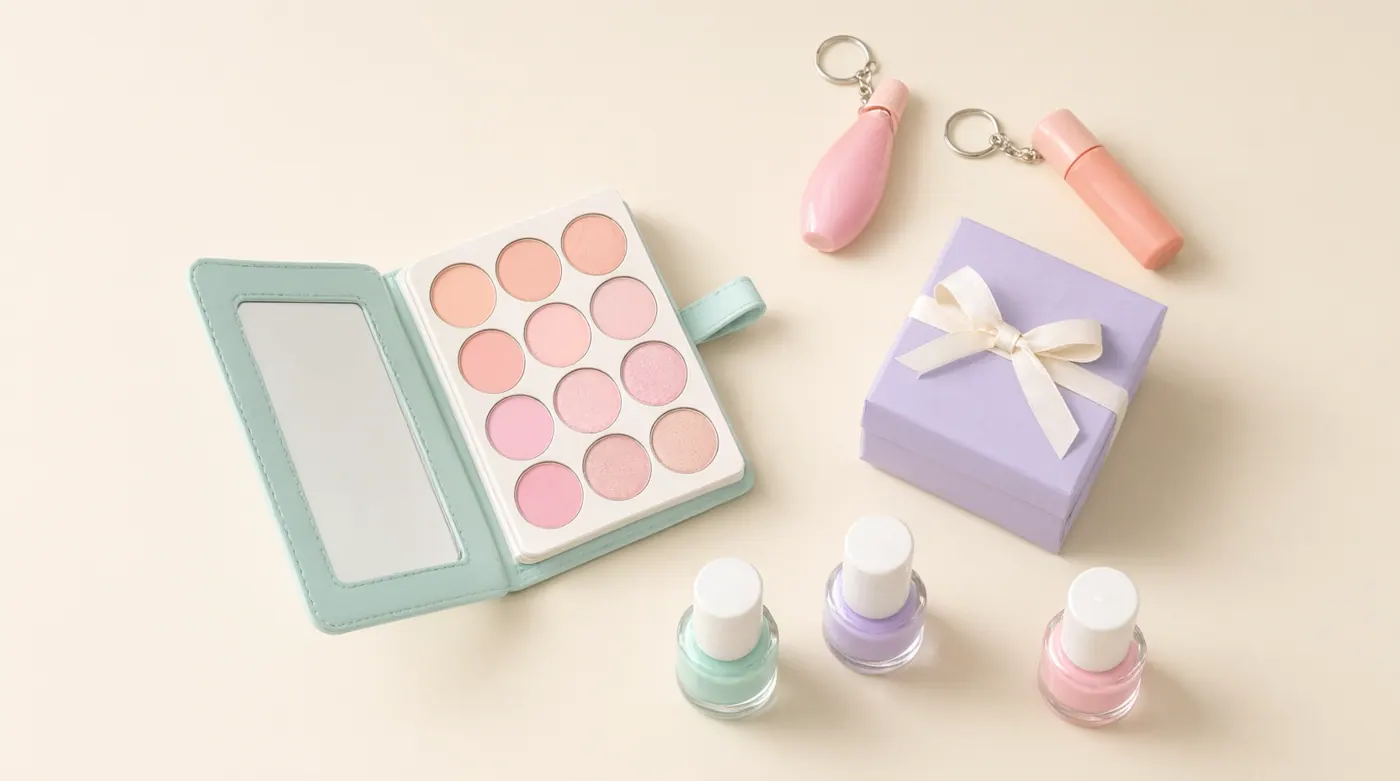
Choosing a kids makeup manufacturer is the easy part. Deciding what actually goes on shelf — and for which age — is where most private label kids makeup projects stall. We have watched both endings. Magic Color has worked in color cosmetics since 2008, and children's and teen makeup is now our core business. The briefs that move fastest are rarely the biggest ones. They fixed the age band first. Formats came second.
Below is the working sequence we run with brands, retail buyers and sourcing managers, from the first range meeting to the container leaving Ningbo or Shanghai. Steal it. It will save you a revision round.
Start with the age band, not the product
The first question a good factory asks you isn't 'what's your target price.' It's 'how old is the child.' Would you give a four-year-old and a ten-year-old the same kit? No. And that gap has nothing to do with marketing. It's formula, format, closure strength, and how a parent reads the pack.
At the young end, parents are buying a play experience. It has to wash off, survive a drop onto tile, and not ruin the sofa. Older kids want what they saw on a phone screen: shine, a mirror, a case to clip on a bag.
- 3–6 years. One or two items only. Think peel-off polish, a tinted balm, one chunky crayon. Texture and easy removal beat shade range every time.
- 6–9 years. This is the volume band for sets. Kids makeup kits holding a small palette, a gloss and a polish outsell single items here, especially around birthdays.
- 9–12 years. Format-driven. Portable, keychain, 'real makeup' look. More shades, better closures, a mirror that survives a school bag.
- 12+. Tween and teen. Skin-tone shades, lip oil, blush balm, mascara. Different category, different review behaviour — see teen and tween makeup.
Positioning is what decides the rules. In the EU, an item sold mainly as a plaything can fall under toy safety rules. Sell the same item as a cosmetic, and the cosmetics regulation applies. Some products sit in both conversations. Have the European Commission's toy safety pages and Regulation (EC) No 1223/2009 open while you design the box. Not after.
Three hero formats that keep selling
You don't need thirty SKUs to launch. Two or three formats will do it — ones that photograph well and survive a nine-year-old's handling.
Notebook palettes
Think of a palette shaped like a notebook. It opens like a book and has a mirror inside. Parents read it as stationery. Kids read it as grown-up. Both like that. That flat inner surface is also the best canvas you'll get for artwork, licensing and gift messaging. We produce several variants, including a teddy fleece notebook and a bear fluffy palette. Both live or die on the hinge and the mirror bond. Ask about drop testing before you fall in love with the rendering.
Keychain glosses
Low unit price. High perceived value. Impulse-friendly at the till. A gloss on a clip becomes a backpack accessory, which is free marketing in a playground. Our keychain gloss set and ice cream pendant gloss follow that logic. Formulation matters more than the shape, though. A sticky gloss gets thrown away. Browse the wider kids lip gloss range for texture options.
Peel-off water-based polish
This format wins the parent argument. Water-based, dries in roughly eight minutes, peels off in one piece, no remover, no acetone smell in the kitchen. It's also the format most easily ruined by a cheap supplier — a badly made peelable film flakes within the hour. Our on-the-go nail polish set is built on that water-based system; the broader range sits under kids nail polish.
Safety and the document pack
Picking a children cosmetics manufacturer is really a document review with a factory attached. Ask for paperwork before you ask for a quote.
Our children's items are produced to EN-71 and CE requirements, with skin irritation testing and oral non-toxicity testing on the formulas. We can supply third-party reports from labs such as SGS, Intertek and CTI per batch on request. Every raw material arrives with a COA. That wording is deliberate. 'Available per batch on request' is what we can honestly promise. If a factory says every shipment automatically comes with a fresh third-party report, it is either billing you for it or guessing.
At the plant, ask for GMPC and ISO 22716 at minimum. Also ask where retained samples sit — controlled temperature and humidity — and how long they're kept. We retain batch samples until six months after the end of the product's shelf life, so a complaint about an old batch is still answerable. Our certifications: GMPC, ISO 22716, BRCGS, SMETA, BSCI and RSPO. We build formulas without talc, phthalates, formaldehyde or heavy metals. Children's formulas usually carry vitamin E, petrolatum and plant extracts such as pomegranate, chamomile or aloe.
For the US, the correct wording is 'compliant with FDA and MoCRA requirements.' The FDA doesn't hand out factory approvals — facility registration and product listing under MoCRA sit with your brand. Read the MoCRA overview on FDA.gov before anything goes to print. Our safety and compliance page lists the market standards we build to for the EU, US, Middle East, Russia, UK, India and ASEAN.
Packaging and the gifting calendar
Kids makeup is a gift category, whether you plan for it or not. Buyers treat it that way. Birthdays. Back-to-school. Diwali, Eid, Christmas, Easter baskets. The peaks are sharp, and the buying window closes early.
Practically, that means two pack architectures. A paper sleeve or printed carton keeps the shelf price lower for everyday retail. An aluminium case or rigid gift box costs more per unit. It photographs better, though, and it holds a gift price point. Choose one hero pack for the holiday push. Use a leaner pack for the rest of the year. Don't ask one pack to do both jobs.
Do the math backwards. Production runs 45 days. Sea freight to North America or Europe adds 30–45 more. Want stock on shelf in early November? Artwork and deposit need to be settled in June. Buyers who start in September are buying for next year. Our wholesale team will work backwards from your launch date with you.
MOQ: the numbers, without the fantasy
MOQ is the most common reason a good concept never ships. That's the short version. Below are our real thresholds. Size the range first — before you fall in love with an electroplated cap.
| Category | MOQ | What drives it |
|---|---|---|
| Basic model with no special process | 6,000 pcs | Stock shell and stock decoration |
| Special process (electroplating, 3D printing, silk-screen, embossing, new mould) | 12,000 pcs | Set-up cost for each run |
| Custom component shells | 12,000 pcs | Tooling amortisation |
| Standard-process sets (standard cases, sleeves, bags, gift boxes) | 3,000 sets | Standard components and decoration |
| Special-process sets (electroplating, 3D printing, silk-screen, embossing, new mould) | 6,000 sets | Decoration and assembly |
Price breaks fall at 12,000, 30,000, 50,000 and 100,000 pieces. My blunt opinion? Three SKUs at 6,000 beats eight smaller runs that no one quotes properly. One clean sell-through teaches you more than a wide catalogue no one reorders.
The timeline from brief to shelf
Roughly, and assuming you answer emails:
- Formula development — 14 days. Includes basic testing and an initial report. The express route is 7 days if you skip compatibility and stability work. Don't skip it on a kids product.
- Samples — 3–7 days. Free; you cover freight. Two revisions free of charge.
- Contract and deposit — 30% typically, with 70% before shipment. T/T and L/C both work.
- Production — 45 days from order confirmation, testing included. There is a 30-day express slot. You get priority scheduling; the full report follows later.
- Shipping. Sea: 30–45 days. Air: 7–15. Courier: 3–7. You can name your own forwarder.
Add it up: a realistic first launch runs four to five months from brief to shelf, plus your own artwork and buyer approval. Anything promising eight weeks end to end is skipping stability work somewhere.
What to ask before you sign
Five questions. That's it. The answers will tell you most of what you need.
- Which lab writes the third-party reports? Can I see one for a comparable kids SKU? (Ours: SGS, Intertek, CTI, on request per batch.)
- Do you retain samples by batch, and where are they stored?
- What's the real MOQ on my exact shell and decoration, not the catalogue average?
- Who handles EU cosmetic product notification and US MoCRA listing — you or me?
- Can I visit the plant? (Yes. Book ahead, and we'll walk you through the workshops, lab, QC room and warehouse.)
Ask any kids cosmetics manufacturer for its retention room, too. Not the showroom. The room where the batch samples sit.
Magic Color runs more than 30 automated production lines across roughly 30,000 m² with close to 400 staff, an automation rate above 70%, 500-plus mature formulas and 600-plus new development samples a year. Today we produce about 300,000 cosmetic sets a month. All filling workshops at the current Jinhua factory are Class 100,000 GMPC cleanrooms. A planned new facility of about 100,000 m² with 45 lines is due to open in 2027. We are a long-term supplier to supermarket chains in Europe and the US. Those names stay off the website. That is how the relationships have lasted.
Want to talk range architecture, or get a sampling brief moving? Contact us. Bring the age band and the shelf price. We'll take the rest of the list.
FAQ
What is the minimum order for private label kids makeup?
Basic models with no special process start at 6,000 pieces. Special processes such as electroplating, 3D printing, silk-screen, embossing or a new mould move to 12,000 pieces. Custom component shells are also 12,000. For sets, standard processes start at 3,000 sets, including standard cases, sleeves, bags and gift boxes; sets with a special process start at 6,000 sets.
How long does it take from brief to shelf?
Formula development is 14 days as standard (7 days express, without compatibility and stability testing). Samples take 3–7 days and are free, with two free revisions. Production is 45 days from order confirmation including testing, or 30 days on an express slot. Sea freight adds 30–45 days, air 7–15 days. Plan on four to five months for a first launch.
Are your kids products tested for safety?
Children's items are produced to EN-71 and CE requirements, and formulas go through skin irritation and oral non-toxicity testing. We can supply third-party reports from labs such as SGS, Intertek and CTI per batch on request. Every raw material comes with a COA. Formulas are made without talc, phthalates, formaldehyde or heavy metals.
Can you match our packaging colours and artwork?
Yes. We match Pantone shades to within ±2 ΔE, offer custom shade development and provide an annually updated shade card. You can choose offset printing, silk-screen, hot stamping, UV, 3D printing and embossing. For kids lines, we usually steer toward macaron and soft pastel shades. Teen ranges open up to nudes, high-saturation and metallic finishes.