Buyer guide
Tween Makeup: Building a First-Makeup Range for Gen Alpha
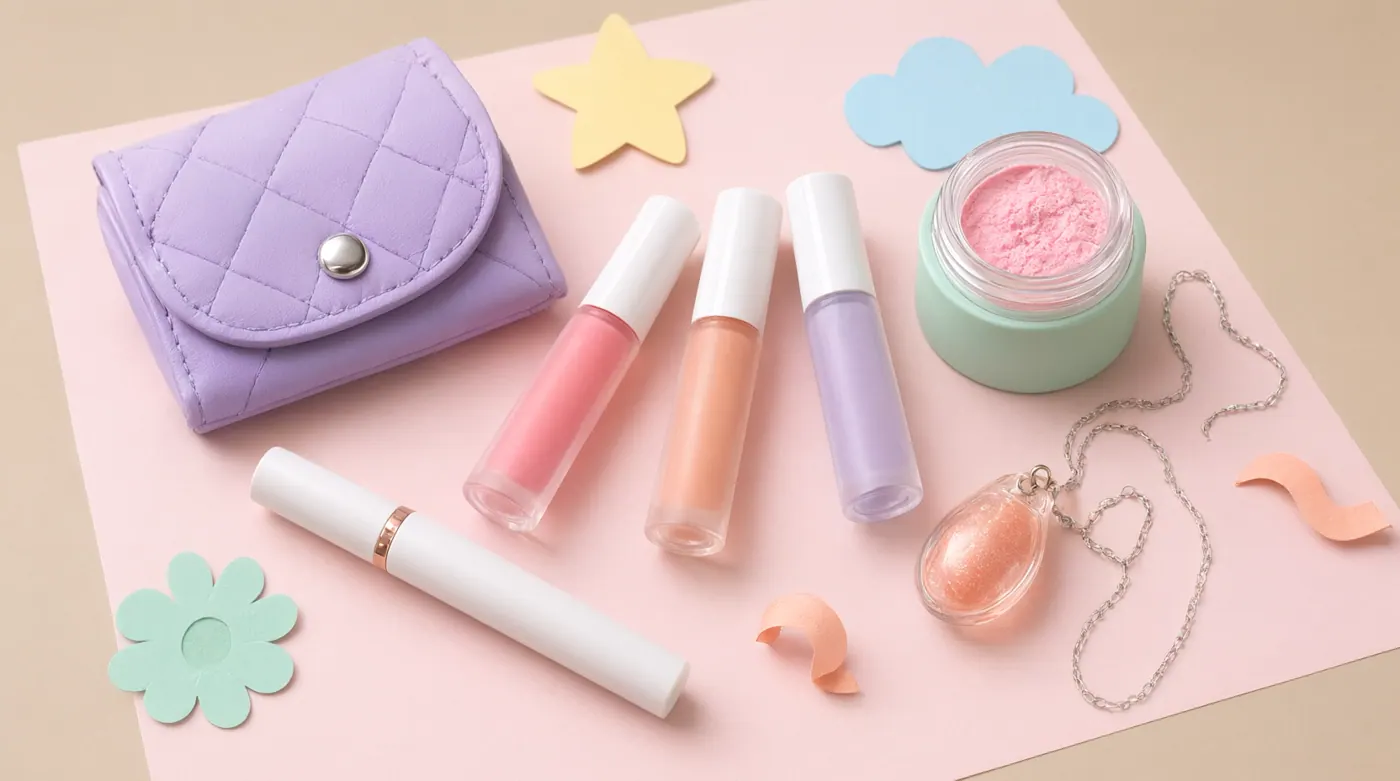
Designing makeup for 10 year olds isn't adult makeup with the numbers turned down. Tween makeup lives in a narrow gap. The child wants something that feels grown-up. The parent wants something that feels safe. And both of them judge your packaging in about four seconds. Get that balance right, and you have a repeat buyer. Get it wrong and you have a birthday gift, one bad review and no reorder.
Magic Color (Jinhua Magic Color Cosmetic Co., Ltd.) has been in color cosmetics since 2008. Kids and tween ranges are now a core part of what we quote. Below is the practical build guide we walk buyers through — what the two decision-makers want, which textures survive a real 10-year-old, where labelling trips people up, and how to keep the range manufacturable at a sane MOQ.
Two Customers, One Product
Watch a parent pick up a tween lip gloss. Three things happen, in order: she reads the front of the pack, flips it over, and looks for a reason to say no. The 10-year-old does one thing — decides whether it looks good on her friend's desk. Your range has to pass both tests in the same four seconds.
So split the brief. The outer pack talks to the parent: age guidance, what the product does, how it comes off, who made it. What's inside talks to the tween: glossy finish, a shade that actually shows on skin, a format worth showing off. A range that only pleases the child sells once. A range that only pleases the parent never leaves the shelf. The tween lines that work do both — usually with fewer than eight SKUs.
Parents compare, too. They'll hold your gloss next to a supermarket kids' set and check whether yours reads as a toy or as a cosmetic. That's the moment clear labelling beats cute labelling, every time.
Sheer and Buildable Is Not a Compromise
New hands aren't accurate hands. Give a 10-year-old a high-pigment matte and she'll get a stripe across her cheek and a story at school. Sheer, buildable textures let her go two or three passes and stay in control. That's the whole design goal: forgiving first, pigmented second.
Cream and mousse formats win at this age. They apply with a fingertip, they don't shatter in a school bag, and they don't throw fallout over a bedroom carpet. Keep the shade story soft — macaron and pastel tones read as “for kids” without tipping into face paint. Save the saturated, glitter-forward shades for the 13-plus side of the range, and label the split clearly.
Lip gloss trios do the heavy lifting
A trio is the most useful format in this category. One SKU carries three shades — a retailer gets a colour story on a single facing, and a buyer can test the market without committing to three separate items. It solves gifting too, which is how a surprising share of tween makeup actually sells.
We build trios as juicy trio lip gloss sets, and the same logic drives single-unit novelty formats: a lip gloss keychain set or a portable pendant lip gloss turns the product into something a tween carries rather than stores. On the formula side, keep it nourishing and unfussy — vitamin E, petrolatum, plant extracts such as pomegranate, chamomile or aloe. Shine and comfort. No tingle, no plumping claims.
More on formats and formulation sits on our kids lip gloss page.
Mousse blush is the sleeper
Mousse blush deserves more shelf space than it gets. It blends with a finger, it's sheer by nature, and one pan works on lips and cheeks. A dual-use mousse blush balm gives a hesitant parent two uses for one purchase — far easier to sell than a dedicated blush with a brush nobody knows how to use.
Gentle primers and a first mascara
Skip the full face. A light, water-based primer that smooths without heavy occlusion is enough. Keep the claims modest: helps makeup sit evenly — not improves your skin.
Mascara is where parent anxiety peaks. For a first mascara, easy removal beats wear time. Waterproof on a 10-year-old is a support email waiting to happen. So give buyers both: a gentle wash-off lengthening formula such as our long volumizing mascara, and a waterproof volumizing mascara held back for the older end — packaged and labelled so the parent knows exactly which one is in her hand.
Packaging That Fits a School Bag
Test the pack the way a child carries it: loose, upside down, next to a water bottle, in a bag that gets dropped. Closure quality matters more than finish. A pendant gloss with a weak thread is a return. A plainer one that never leaks is a reorder.
Formats that work at this age: keychain and pendant units, slim dual tubes like our milk tea cup dual lip gloss set, pocket palettes such as the unicorn pocket sparkle set, and carry-all cases like the carry-all cosmetic set for gift-led retail. Nothing bigger than a hand. Nothing heavier than a phone. No loose powder.
Packaging choice also drives your MOQ, so decide early. Sets with standard processes — cases, sleeves, bags and gift boxes — start at 3,000 sets; sets with special processes start at 6,000 sets. Those special processes — electroplating, 3D printing, silk screen, embossing, custom moulds — move component MOQs to 12,000 pieces. Better to know that before the artwork is signed off than after.
Range Architecture: Six SKUs That Cover It
You don't need a 30-piece line for a first launch. Six well-chosen items cover the play, the gift and the age-up step.
| Format | Role in the range | MOQ reference |
|---|---|---|
| Lip gloss trio | Colour story on one facing | 6,000 pcs basic / 12,000 special process |
| Dual-use mousse blush | Two uses, one purchase | 12,000 pcs for custom shells |
| Pendant or keychain gloss | Impulse and carry-along | 12,000 pcs special process |
| Gentle primer | Parent reassurance | 6,000 pcs basic |
| Wash-off first mascara | The age-up step | 6,000 pcs basic |
| Carry-all gift set | Q4 and birthday gifting | 3,000 sets standard process / 6,000 sets special process |
Labelling: Clarity Beats Cute
Regulators read your label. So do parents. In the EU, cosmetic products need a responsible person established in the EU, an ingredient list using INCI naming, and a period-after-opening marking where it applies — all under Regulation (EC) No 1223/2009. In the US, the FDA cosmetics labelling rules cover the ingredient declaration, net quantity and name and place of business, plus warnings where a product needs them. US entry also runs through FDA and MoCRA requirements, which include facility registration and product listing for cosmetics.
Three things get buyers into trouble. Absolute claims — “100% safe”, “allergen-free”, “chemical-free” — none of which you can defend. Printing a certification logo the factory doesn't hold. And no age guidance at all, which leaves the parent guessing in the aisle. So put an age band on the front, a removal instruction (“washes off with water”) on the back, and keep every claim inside what your test reports actually support.
We run a living compliance database across Europe, the US, South America, the Middle East and Southeast Asia, tracking restricted ingredients and labelling rules. Boring work? Maybe. It also decides whether your second purchase order ships.
The Safety Approach Behind the Formula
Kid-facing formulas we produce leave out talc, phthalates, formaldehyde and heavy metals. Raw materials arrive with a COA and are filed by batch. Kids items are built to EN-71 and CE requirements, and go through skin irritation and oral non-toxicity testing. Want third-party proof? Reports from SGS, Intertek or CTI are available per batch on request, and retained samples sit in a constant-temperature, constant-humidity room until six months after the end of the product's shelf life for traceability.
Write “suitable for sensitive skin, patch test advised”, not “safe for all skin types”. The second one is indefensible, and buyers know it. Full detail sits on our safety and compliance page; our teen and tween makeup page covers the category in more depth.
Make It Manufacturable
We hold 500-plus mature formulas and produce over 600 new development samples a year — so a tween range usually starts from an existing base, not a blank page. Formula development runs 14 days as standard, 7 days express without compatibility and stability testing. Production is 45 days standard, 30 days express. Samples take 3–7 days, are free, and you cover freight. Two revisions included.
Current sets capacity is 300,000 cosmetic sets a month. All filling workshops in our current Jinhua factory are Class 100,000 GMPC cleanrooms. A new facility of about 100,000 m² with 45 lines is due to open in 2027. Company certifications: GMPC, ISO 22716, BRCGS, SMETA, BSCI and RSPO. Shelf life is 3 years unopened, 12 months after opening. Payment is typically 30% deposit, 70% before shipment, by T/T or L/C. Price breaks fall at 12k, 30k, 50k and 100k pieces — worth modelling before you fix retail pricing.
That matters more than unit price. A tween range that ships late misses the gifting season entirely — and gifting is where the volume is.
Where to Start
Pick one hero format, one supporting texture and one gift SKU. Test the label with five parents before you print it. Then scale the shades once sell-through tells you which one wins.
Send us your target market and retail price band via the contact page, or read the wholesale overview for MOQ, lead times and sampling. We'll come back with a format shortlist and a costing at your quantity.
FAQ
What makes makeup for 10 year olds different from adult makeup?
Texture and labelling. Tweens need sheer, buildable colour they can apply with a fingertip and correct without a mirror, so cream and mousse formats usually beat pressed powders. The outer pack has to answer a parent's safety and removal questions in seconds, which means clear age guidance and honest claims rather than maximum shelf drama.
What is a realistic MOQ for a first tween makeup range?
Basic models without special processes start at 6,000 pcs. Electroplating, 3D printing, silk screen, embossing or a custom mould pushes component MOQs to 12,000 pcs. Sets with standard processes start at 3,000 sets; sets with special processes start at 6,000 sets.
How long does development and production take?
Formula development is 14 days standard or 7 days express, though the express route skips compatibility and stability testing. Production runs 45 days standard or 30 days express from order confirmation to dispatch. Samples take 3–7 days, are free, and you pay freight only. Two revisions included.
What labelling do I need for tween makeup in the EU and the US?
In the EU, Regulation (EC) No 1223/2009 requires a responsible person established in the EU, an INCI ingredient list and a period-after-opening marking where applicable. In the US, FDA cosmetics labelling rules cover the ingredient declaration, net quantity, name and place of business and any required warnings; FDA and MoCRA requirements also cover facility registration and product listing.